


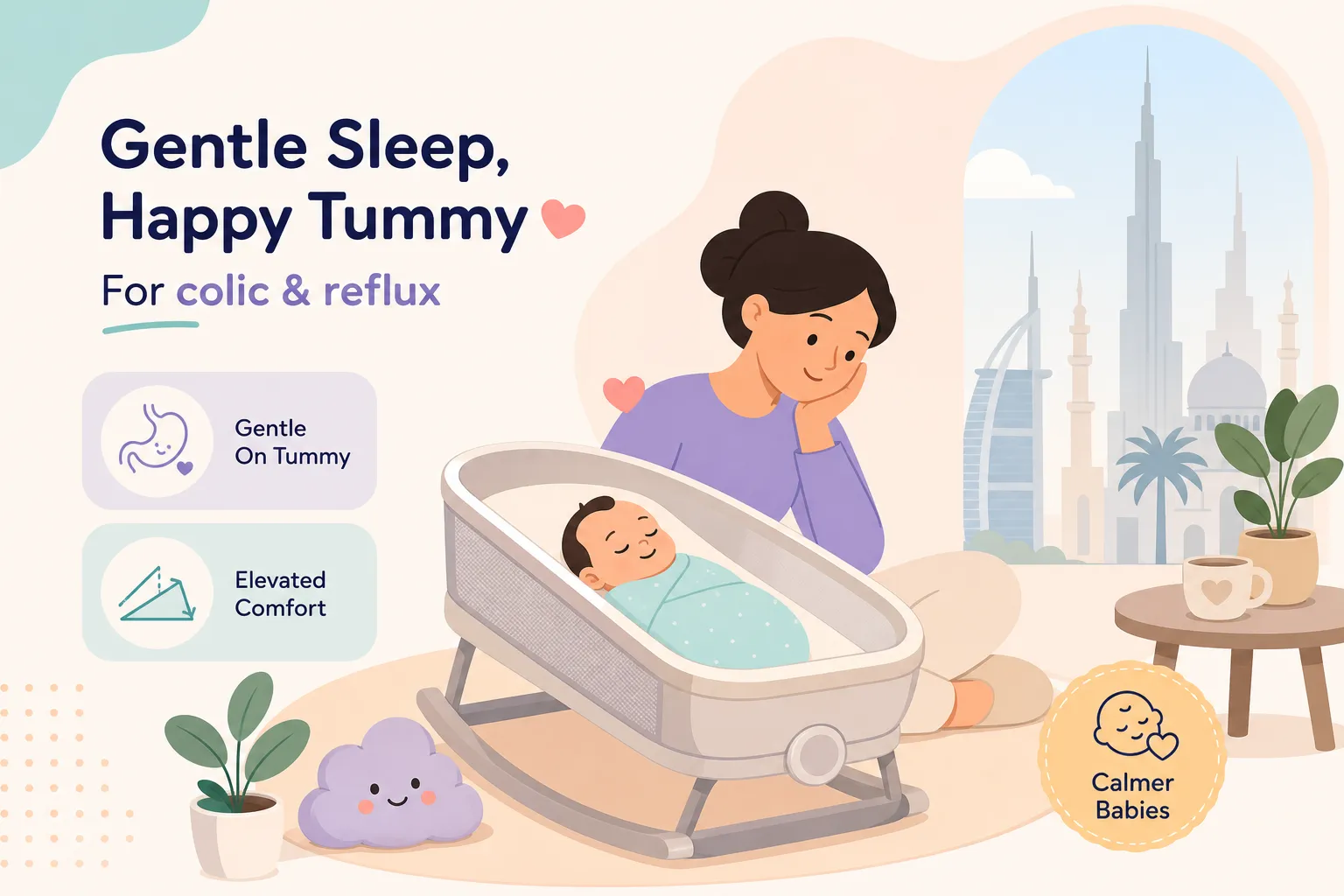
If you're asking what is the best baby cradle for colic and reflux, you're likely running on very little sleep and a lot of worry. It's 3am, your baby has been awake for the third time tonight, arching their back, refusing to settle. You've watched the spit-up happen again after lying them flat, and your instinct is telling you that a different cradle, the right one, must be the answer. It's also where a lot of exhausted UAE parents end up making expensive purchases they later regret.
Reflux and colic are genuinely hard. They disrupt sleep, create anxiety, and turn the first weeks of parenthood into a fog of trial and error. The cradle market is full of products making bold promises about angles, inclines, and anti-vomit positioning. But the science behind those claims is not what the packaging suggests, and some of those products carry real safety risks. This guide gives you the facts: what pediatricians actually say, which features genuinely help, and which cradles UAE parents are choosing in 2026 with confidence.
Why reflux and colic turn sleep into a nightmare
Infant reflux (GER) happens when the lower esophageal sphincter, the valve between the stomach and the esophagus, is immature and allows stomach contents to push back up. Many parents notice that their babies seem more unsettled after bedtime feeds, though it's worth noting that pediatric research does not consistently show that lying flat worsens reflux symptoms. Most babies outgrow GER between four and six months as that sphincter matures. GERD (gastroesophageal reflux disease) is a more severe version requiring medical input, but it is far less common than the everyday reflux most parents are dealing with.
Colic is a different problem entirely. It is defined clinically as crying for more than three hours a day, three days a week, for three weeks or more, with no diagnosable cause. Gas buildup, gut immaturity, and overstimulation are the leading theories, not stomach acid. This distinction matters because parents often reach for the same solution for both conditions when they actually need different responses. Treating colic as a reflux problem, or vice versa, leads to product purchases that miss the mark entirely.
When a parent sees their baby spit up after lying flat, the conclusion feels natural: the surface must be the problem. But understanding what is actually happening in your baby's gut helps you choose solutions that work rather than solutions that are simply marketed well. It also keeps you away from products that look reassuring on a product listing and create real hazards in the crib.
What pediatric safety guidelines actually say about inclined sleepers
The American Academy of Pediatrics (AAP) is direct on this point: all infants, including those with reflux, should sleep flat on their back on a firm, non-inclined surface. This is not a cautious suggestion; it is a firm safety standard. Inclined sleepers can position a baby's chin toward their chest, restricting the airway. The tragic recall of products like the Rock 'n Play, linked to over 30 infant deaths in the United States, is the clearest evidence of what happens when inclined sleep products enter mainstream use.
The U.S. Consumer Product Safety Commission (CPSC) has since codified this into law. Under the Safe Sleep for Babies Act, any infant sleep product with a surface angle greater than 10 degrees is prohibited. This threshold was established through biomechanical research confirming that inclines of 20 degrees or more put infants at significant airway risk. A surface of 10 degrees or less is considered comparable to flat for safety purposes. UAE parents shopping across international marketplaces should treat this standard as a baseline minimum when evaluating any anti-reflux bassinet or baby rocker for colic.
Perhaps the most important thing to understand is that inclined sleepers do not reduce reflux. Peer-reviewed research published in pediatric gastroenterology literature, including studies using pH monitoring across different incline angles, found no significant reduction in regurgitation episodes when infants were placed on inclined surfaces compared to flat ones. Research has found that positioning at steep angles can actually increase reflux compared to flat positioning, and that head elevation increases abdominal compression, worsening symptoms. The angle that feels intuitively helpful is not delivering clinical benefit, and it is introducing real risk.
There is one narrow exception. Infants with specific upper airway anatomical disorders, where protective airway mechanisms are impaired, may receive an individual medical recommendation for positioning. For the vast majority of reflux and colic babies, this does not apply, and no product listing changes that fact.
What actually helps a baby with reflux and colic: motion, feeding, and honest expectations
While inclines don't reduce reflux, gentle rocking motion has a genuine soothing effect on unsettled babies. It mimics the rhythmic movement of the womb, activates the vestibular system, and helps settle overtired or gassy infants. The motion itself is the therapeutic element, not the angle. A flat cradle with smooth rocking action, sometimes called an anti-reflux bassinet when paired with correct positioning, is a fundamentally different product from a steeply inclined sleeper, and it is the type of colic relief cradle that aligns with general pediatric guidance on soothing tools.
The interventions with the strongest clinical backing for reducing reflux symptoms are all feeding-based. Offering smaller, more frequent feeds reduces the volume load on the stomach. Thorough burping at natural pauses, every one to two ounces for bottle-fed babies, prevents gas buildup that mimics reflux discomfort. Keeping baby upright for 20 to 30 minutes after each feed, while awake and supervised, gives digestion a head start before the flat sleep surface comes into play. These steps cost nothing and have more evidence behind them than any sleep surface angle.
Once you understand that the cradle is a comfort tool rather than a medical treatment, you can choose one based on the features that actually matter: a firm flat surface, breathable sides, gentle motion, and practical design built for real-world UAE parenting. That is what distinguishes the best baby cradle for colic and reflux from a well-packaged product that simply looks like one.
What is the best baby cradle for colic and reflux: features that matter
A firm, flat mattress is non-negotiable. The AAP and CPSC both advise a firm surface that does not noticeably indent under an adult hand, avoid cradles with pillow-like padding built into the sleep surface, and skip any product that markets a wedge insert as a standard feature. Soft surfaces increase suffocation risk, particularly for young infants who cannot reposition themselves.
Mesh sides serve two practical purposes. They allow you to see your baby clearly from across the room, and they maintain airflow around the sleep surface. For a reflux baby who may turn their head during sleep, ventilation matters. Fully enclosed or heavily padded-side designs with limited airflow are worth avoiding.
When evaluating the rocking mechanism, look for smooth, controlled motion rather than sharp or motorized jolting. Some cradles offer a manual glide; others have an auto-rocking function. Either works for settling a fussy baby. The key consideration is that the motion can be stopped or locked once your baby is asleep, keeping the surface stable through the night.
UAE-specific practicalities are worth factoring in. Mosquito nets matter in the Gulf, particularly during summer months. Adjustable height for bedside co-sleeping makes nighttime feeds less disruptive. One-hand rocking and tool-free assembly are small features that feel significant when you are running on three hours of sleep.
Top cradle picks for UAE parents in 2026
The Elvelin CozyNest is a strong option for UAE parents navigating newborn sleep challenges. It combines a firm, flat sleep surface with gentle rocking motion and a design built around the real conditions of Gulf parenting: warm environments, travel between emirates, and the need for products that work without a steep learning curve. What makes it particularly practical is the educational layer Elvelin includes alongside it. Every CozyNest comes with the Elvelin Baby Healthy Sleep Guide, which covers awake windows, sleep conditioning, and safe sleep practices in plain language for new parents. The educational support matters as much as the hardware. CozyNest is available through the Elvelin online store with delivery across the UAE.
For parents exploring mid-range alternatives, the Teknum Dark Grey Moonlight Bedside Crib (available at BabyStore.ae, currently around AED 399) is worth considering. It features mesh sides, a rocker mode, adjustable height for bedside positioning, and a mosquito net. If you choose this one, use it with the incline setting flat and rely on it for the rocking and bedside co-sleeping functions only. The 5-in-1 portable crib from Carrefour UAE (around AED 379) is another practical choice with a rocking mode and convertible design for families who need flexibility across different spaces.
Knowing what to avoid is just as important as knowing what to buy. Baby pods, nest-style loungers, and anti-vomit wedge pillows are widely marketed for reflux across UAE online marketplaces, often with convincing product descriptions. These are not safe sleep surfaces for unsupervised sleep, regardless of what the listing claims. Per AAP and CPSC guidance, they are discouraged for unsupervised infant sleep because they typically feature steep inclines, soft surrounding fabric, and no firm flat surface. Using them while you are watching your baby closely is a different conversation; using them as a primary sleep product is not.
Choosing with confidence, not just hope
The parent searching for the best baby cradle for colic and reflux at 3am doesn't need the steepest incline or the most convincing marketing copy. They need to know what is actually happening with their baby, which features of a cradle provide real comfort, and which products are safe enough to sleep beside. That is exactly the kind of decision this guide is designed to support.
The science is clear: flat sleep surfaces with gentle rocking motion, combined with smart feeding adjustments, give reflux and colic babies the best chance of settling. A colic relief cradle built on those principles, from a brand that also provides the educational support to use it well, is worth far more than one with an impressive angle and a bold label.
Elvelin's CozyNest is available now through the Elvelin online store, with delivery across the UAE. Pair it with the free Elvelin Baby Healthy Sleep Guide for practical guidance on routines, awake windows, and safe sleep practices that match the exhausting, rewarding reality of new parenthood. Browse the CozyNest and start sleeping smarter tonight.